Nanostructures and Computation Group Members
The Nanostructures and Computation Group is headed by Prof. Steven G. Johnson in the Department of Mathematics at MIT, who joined the MIT faculty in 2004.
Current Group Members
The current graduate and undergraduate students working in the group are (in decreasing order of seniority):
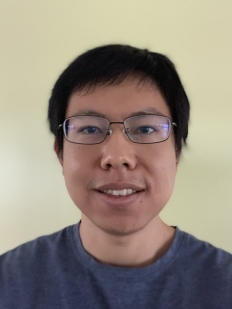 ⇨Wenchao Ma (mawc ατ mit.edu) is a graduate student in chemistry at MIT, working on photonic inverse design for photochemical systems.
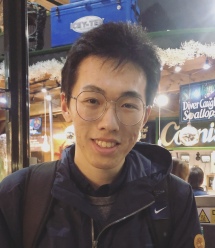 ⇦Mo Chen (mochen ατ mit.edu) is a graduate student in applied mathematics at MIT, working on PDE-constrained optimization.
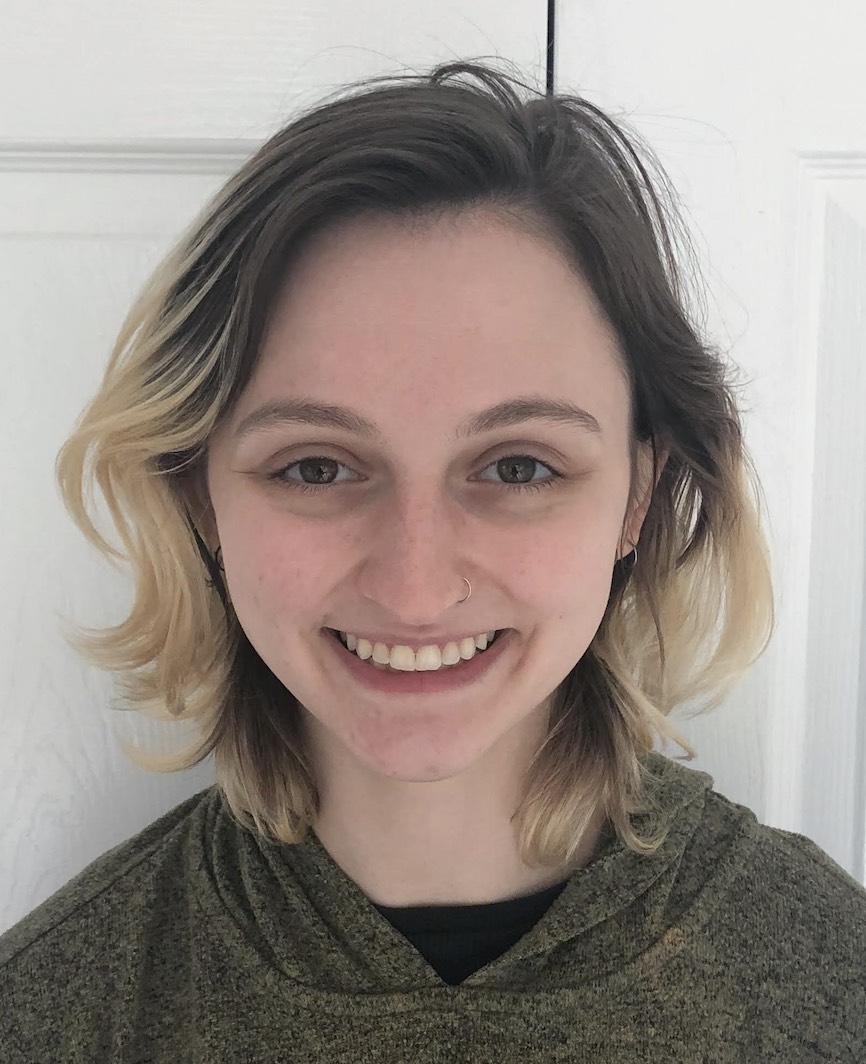 ⇨Sophie Fisher (sefisher ατ mit.edu) is a graduate student in electrical engineering at MIT, working on coupled-wave methods for optical metasurfaces.
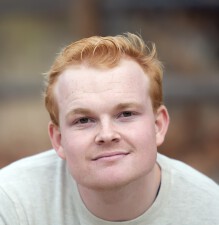 ⇦Ian Hammond (ihammond ατ mit.edu) is a graduate student in electrical engineering at MIT working on nonlinear resonance problems.
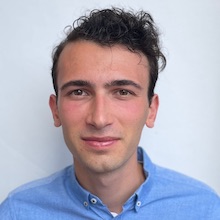 ⇨Lorenzo Van Muñoz (lxvm ατ mit.edu) is a graduate student in physics at MIT working on computational methods for inverse design, mode cleanup, and quadrature of resonant responses.
- William Li (wfli ατ mit.edu) is an undergraduate physics major at MIT working on paraxial light-angle detection using compressed sensing, LISTA, and end-to-end photonics optimization.
- Gaurav Arya (aryag ατ mit.edu) is an undergraduate math major at MIT working on end-to-end super-resolution metasurfaces for natural images by compressed sensing.
- Jaden Thomas-Markarian (jthomasm ατ mit.edu) is an undergraduate physics/math major working on localization theorems for discrete wave systems (phonons).
Graduated group members
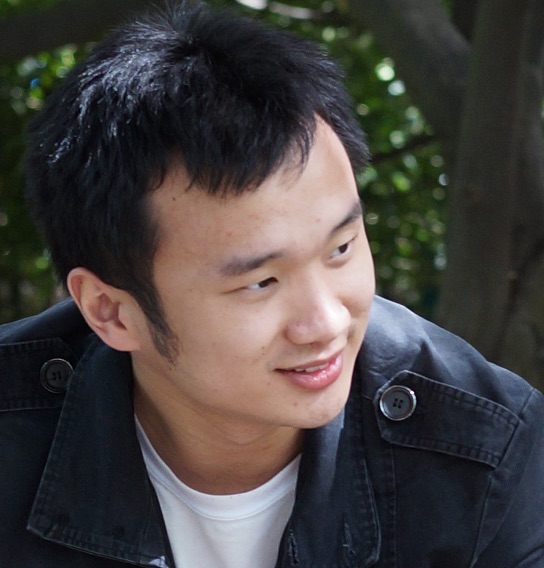 ⇨Wenjie
Yao (jayyao0917 ατ hotmail.com), Ph.D. Electrical Engineering (August 2022): Inverse Design of Random Emitters in Nanophotonics. Currently an engineer at Huawei.
⇨Wenjie
Yao (jayyao0917 ατ hotmail.com), Ph.D. Electrical Engineering (August 2022): Inverse Design of Random Emitters in Nanophotonics. Currently an engineer at Huawei.
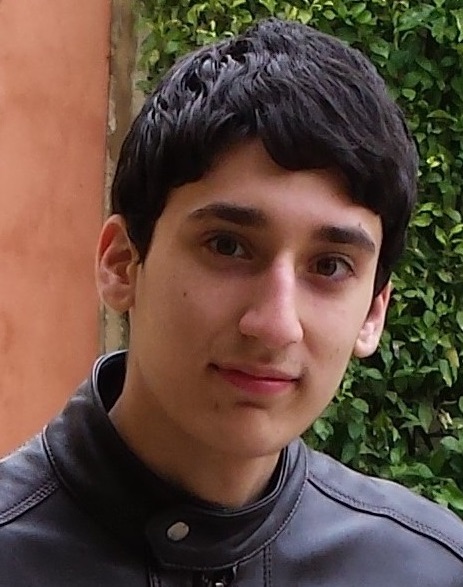 ⇦Mohammed Benzaouia (medbenzaouia ατ gmail.com). Ph.D. Electrical Engineering (October 2021). On Applications of Resonances, from One to Infinity. Currently a postdoc at Stanford.
 ⇨Raphaël Pestourie (raphael.pestourie ατ gmail.com). Ph.D. Applied Mathematics (Dec 2019), Harvard. Assume Your Neighbor Is Your Equal: Inverse Design in Nanophotonics. Currently a professor in the School of Computational Science and Engineering at Georgia Tech.
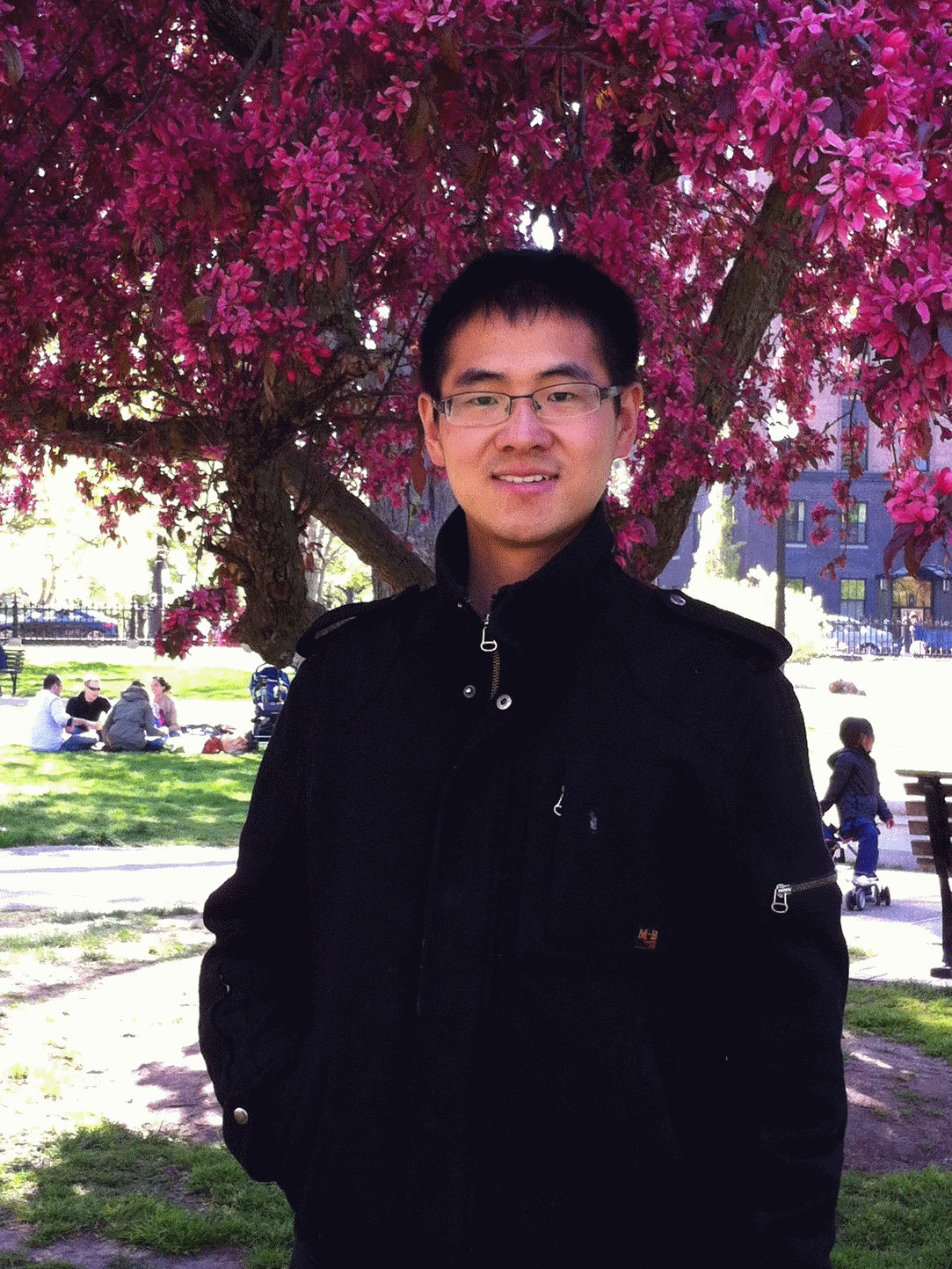 ⇦Fan Wang (fwangmit ατ gmail.com). Ph.D. Mechanical Engineering (Aug 2019), MIT. New modeling of compact, high-efficiency, and widely-tunable gas-phase terahertz lasers. Currently at Tencent.
 ⇨Adi Pick (Adi.Pick ατ mail.huji.ac.il). Ph.D. Physics (Aug 2017), Harvard University. Spontaneous Emission in Nanophotonics. Currently a professor in the Faculty of Science at the Hebrew University of Jerusalem.
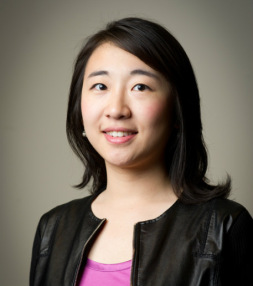 ⇦Yoon Kyung "Eunnie" Lee (eunnie12 ατ alum.mit.edu). Ph.D. Mechanical Engineering (June 2017), co-advised by Prof. Nicholas X. Fang. Optimal wavefronts and subwavelength structures:
Computer-agided design for optics and acoustics. Currently an associate at Latham & Watkins.
⇦Yoon Kyung "Eunnie" Lee (eunnie12 ατ alum.mit.edu). Ph.D. Mechanical Engineering (June 2017), co-advised by Prof. Nicholas X. Fang. Optimal wavefronts and subwavelength structures:
Computer-agided design for optics and acoustics. Currently an associate at Latham & Watkins.
 ⇨David Liu (xdavidliu ατ gmail.com), PhD Physics (Sep 2015): Nonlinear Design in Nanophotonics. Currently at Google.
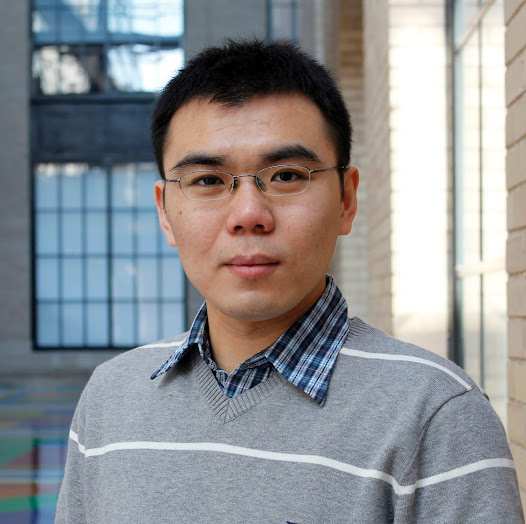 ⇨Xiangdong Liang (xdliang ατ
gmail.com), PhD Mathematics (Feb 2013): Modeling of Fluids and Waves with Analytics and Numerics. Currently a Senior Software Engineer at Instacart.
⇨Xiangdong Liang (xdliang ατ
gmail.com), PhD Mathematics (Feb 2013): Modeling of Fluids and Waves with Analytics and Numerics. Currently a Senior Software Engineer at Instacart.
 ⇦Hila
Hashemi (hila ατ math.mit.edu), PhD Mathematics (Jan 2012): Geometric Manipulation of Light: From Nonlinear Optics to Invisibility Cloaks. Currently an Applied Scientist at Amazon.
⇦Hila
Hashemi (hila ατ math.mit.edu), PhD Mathematics (Jan 2012): Geometric Manipulation of Light: From Nonlinear Optics to Invisibility Cloaks. Currently an Applied Scientist at Amazon.
 ⇨Alexander McCauley (mccauley ατ mit
døt edu), PhD Physics (August 2011): Novel applications of Maxwell's equations to quantum and thermal phenomena. Currently working in Machine Learning and Perception at at Snap Inc..
⇨Alexander McCauley (mccauley ατ mit
døt edu), PhD Physics (August 2011): Novel applications of Maxwell's equations to quantum and thermal phenomena. Currently working in Machine Learning and Perception at at Snap Inc..
 ⇦Ka Yan Karen Lee (kylkaren
ατ mit.edu), PhD Electrical Engineering (May 2011): Understanding new regimes for light-matter interactions. Currently lecturer at The Chinese University of Hong Kong.
⇦Ka Yan Karen Lee (kylkaren
ατ mit.edu), PhD Electrical Engineering (May 2011): Understanding new regimes for light-matter interactions. Currently lecturer at The Chinese University of Hong Kong.
 ⇨M. T. Homer
Reid (homer ατ homerreid.com)
PhD Physics (Dec 2010), co-advised by Prof. Jacob
White: Fluctuating surface currents: a new algorithm for efficient prediction of Casimir interactions among arbitrary materials in arbitrary geometries".
⇨M. T. Homer
Reid (homer ατ homerreid.com)
PhD Physics (Dec 2010), co-advised by Prof. Jacob
White: Fluctuating surface currents: a new algorithm for efficient prediction of Casimir interactions among arbitrary materials in arbitrary geometries".
- André Kurs (andrekurs ατ gmail.com) PhD Physics (Dec 2010), co-advised by Prof. Marin Soljacic: Novel resonance-assisted electromagnetic transport phenomena. Currently founder at OmniZare.
 ⇦Alejandro
W. Rodriguez, PhD Physics
2010: Fluctuation-Induced
Interactions and Nonlinear Nanophotonics. Currently: Associate
Professor of Electrical Engineering, Princeton University.
⇦Alejandro
W. Rodriguez, PhD Physics
2010: Fluctuation-Induced
Interactions and Nonlinear Nanophotonics. Currently: Associate
Professor of Electrical Engineering, Princeton University.
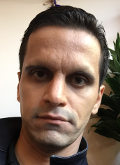 ⇨Ardavan Oskooi, ScD Materials Science and Engineering 2010: Computation & Design for Nanophotonics. Currently an engineer at Google X.
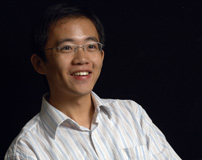 ⇦Lei
Zhang, PhD Department of Electrical Engineering and Computer Science 2010 (co-advised with Prof. Jacob
White): A Boundary Element Method with Surface Conductive Absorbers for 3-D Analysis of Nanophotonics. Currently at UBS Investment Bank.
⇦Lei
Zhang, PhD Department of Electrical Engineering and Computer Science 2010 (co-advised with Prof. Jacob
White): A Boundary Element Method with Surface Conductive Absorbers for 3-D Analysis of Nanophotonics. Currently at UBS Investment Bank.
Former postdoctoral and visiting researchers
- Daniel Lloyd-Jones (daniel.lloyd-jones20 ατ imperial.ac.uk) was a visiting student in 2023 from Imperial College London, working on oblique-wave incidence in FDTD simulations.
- Simon Mataigne (simon.mataigne ατ student.uclouvain.be) was a visiting student in 2022 from UC Louvaine (via the MIT-Belgium program) working on numerical linear algebra for real-antisymmetric matrices, developing the SkewLinearAlgebra.jl software package.
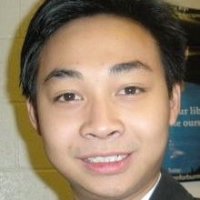 ⇨Zin Lin (zinlin.zinlin ατ gmail.com) was a postdoctoral research associate from 2018–2022, who worked on topology optimization and inverse-design methods for large-scale photonics devices and computational imaging. Currently Assistant Professor of Electrical Engineering at Virginia Tech.
 ⇨Rasmus Christiansen (raelch ατ mek.dtu.dk) was a visiting postdoctoral researcher in 2019. Currently an Assistant Professor of Mechanical Engineering at the Technical University of Denmark (DTU).
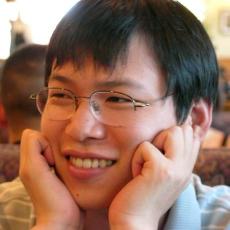 ⇨Wonseok Shin was a postdoc and applied-math instructor from 2015-2018, who received is PhD in 2013 from Stanford with Shanhui Fan. Currently at MIT Lincoln Laboratory.
 ⇨Owen Miller (owen.miller ατ yale.edu), postdoctoral researcher 2012–2016, is currently an Assistant Professor of Applied Physics at Yale.
- Liang Jie Wong (liangjie.wong ατ ntu.edu.sg) postdoctoral researcher 2013–2014, currently Assistant Professor at Nanyang Technological University.
- Jean-Christophe
Nave, postdoctoral researcher 2009–2010, currently Assistant
Professor, Department of Mathematics and Statistics, McGill
University.
 ⇨Zhuanfang Bi (bizhuanfang
ατ gmail.com) was a visiting PhD student in 2010–2011 from Shandong University working
on the design and fabrication of nonlinear-optical devices (resulting in this paper), who received her PhD from Shandong in 2012. Currently a lecturer at Beihang University.
⇨Zhuanfang Bi (bizhuanfang
ατ gmail.com) was a visiting PhD student in 2010–2011 from Shandong University working
on the design and fabrication of nonlinear-optical devices (resulting in this paper), who received her PhD from Shandong in 2012. Currently a lecturer at Beihang University.
Former undergraduate researchers
- Daniel Ogbe (dogbe ατ mit.edu) was a sophomore math major who worked on topology optimization of topological defects for wave localization.
- Gaurav Arya (aryag ατ mit.edu) was a sophomore math major at MIT working on nesting compressed sensing in end-to-end photonics optimization (resulting in this paper).
- Emily Cheng (emilych ατ mit.edu) was a sophomore math major at MIT working on network visualization methods for departmental course offerings and roadmaps in consultation with the MIT Council for Math Majors.
- Lorenzo Van Muñoz (lxvm ατ caltech.edu) was a rising-senior physics major at Caltech working on numerical methods for electromagnetic scattering through variable surface-impedance structures.
- Luke Qi (lukeqi7 ατ mit.edu) was a fourth-year undergraduate physics/EE major at MIT who worked on numerical methods for electromagnetic scattering through variable surface-impedance structures.
- Andy Xu was a first/second-year MIT math major who worked on Gaussian quadrature schemes for Matsubara summation.
- August Trollbäck was a junior at MIT in mathematics and electrical engineering, working on a UROP project involving evaluation of exponential integrals and continued fractions; the results were merged into the Julia SpecialFunctions package.
- Jerrell Cockerham from Colorado College mathematics worked on an MSRPx project involving slowly varying approximations for optical metasurfaces in summer 2020.
- Nolan Reilly worked on methods for improving Cwikel's bound in Schrodinger problems.
- Beatrice Nash worked on nonlinear eigensolver methods in fall 2017.
- Patrick Ledwidth was an undergraduate UROP student working on monotonicity theorems for dispersion relations and spectral inequalities in Maxwell equations in 2016.
- Felipe Hernández worked on numerical methods for Jordan chains (published here) in 2015–2016.
- Sandeep Silwal was an undergraduate UROP student working on numerical methods for special functions in fall 2015.
- Aryan Khojandi was an undergraduate math major working
on fluid instabilities in extensional multilayered capillary flows in summer 2013 – spring 2014.
- Amyas Chew was an undergraduate physics major working on optical "billiard-ball" chaos, in collaboration with Prof. Yidong Chong at NTU in summer 2014.
- Erin Tomlinson worked on nonequilibrium Casimir forces (published here) in summer/fall 2014.
- Songtai Li, MIT physics, worked on phase-insensitive cylindrical "cloaking" in spring 2014.
- Alejandro Garcia (acgarcia ατ mit.edu)
worked on a UROP project
involving integral-equation solvers and low-loss THz mirrors in fall 2012.
- Amy Guyomard (amyguyomard ατ mit.edu), MIT mathematics, worked on computational modeling of
fluid instabilities in capillaries with strong thermal gradients in fall 2012 (published here).
- Rodrigo Muñoz (rodmk ατ mit.edu), MIT
computer science, worked on a UROP project involving
the Pochoir
compiler project for cache-oblivious stencil algorithms.
- Noam Buckman worked on "wagon-wheel" optical resonantors in summer/fall 2013.
- Thanard Kurutach (kurutach
ατ mit.edu), MIT
mathematics and EECS, working on a UROP project involving nonlinear
eigenproblems arising in integral-equation formulations of
electromagnetic scattering problems.
- Rolando La Placa (laplaca ατ college.harvard.edu), an undergraduate physics major at Harvard, worked on light extraction for spontaneous emission.
- Jorge Perez, MIT physics, worked on the computational modelling of Casimir forces in nanostructured geometries.
- David Ramirez (d_ram ατ mit
døt edu), MIT physics,
worked on a UROP project involving intra-cavity nonlinear frequency
conversion, co-advised by Prof. Marin Soljacic, resulting in this paper. Currently a graduate student in physics at Stanford.
- Thomas Alcorn, MIT physics, worked on Casimir forces in glide-symmetric geometries and four-wave mixing in cavities (published here) in fall 2011 and summer 2012.
- Katherine Rudolph, MIT Math, worked on nonequilibrium corrections to Casimir levitation in summer 2011.
 ⇨Jaime Varela, MIT physics, worked on a UROP project involving multi-body Casimir interactions in fluids, resulting in this paper. Currently a graduate student in physics at Berkeley.
 ⇦Amy Zhang, MIT EECS, worked on a UROP project involving perfectly matched layer (PML) absorbing
boundaries.
⇦Amy Zhang, MIT EECS, worked on a UROP project involving perfectly matched layer (PML) absorbing
boundaries.
- Issac Buenrostro, worked on adaptive mesh-refinement for integral-equation
Casimir-force computations. Currently at Stanford.
- Arthur Parzygnat, an undergraduate at Queen's college (class of
2010) who spent the summer of 2009 working on a project involving
rigorous conditions for localization in band gaps, resulting in this paper.
 ⇨Thanasin Nampaisarn is an undergraduate physics/math student
at MIT from Thailand who worked on a summer project involving
simultaneous localization of light and sound by simultaneous
three-dimensional phononic and photonic band gaps.
⇨Thanasin Nampaisarn is an undergraduate physics/math student
at MIT from Thailand who worked on a summer project involving
simultaneous localization of light and sound by simultaneous
three-dimensional phononic and photonic band gaps.
- Nathan Lachenmyer is an undergraduate in the physics department
who worked on a summer UROP project involving quantum Casimir torques.
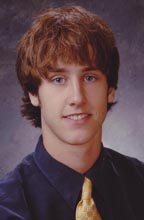 ⇨Bryn
Waldwick (waldwick ατ mit døt
edu) worked on a UROP project involving bending
losses in hollow-core Bragg fibers. He is also on the MIT golf team,
and enjoys playing basketball as well as the saxophone and guitar.
⇨Bryn
Waldwick (waldwick ατ mit døt
edu) worked on a UROP project involving bending
losses in hollow-core Bragg fibers. He is also on the MIT golf team,
and enjoys playing basketball as well as the saxophone and guitar.
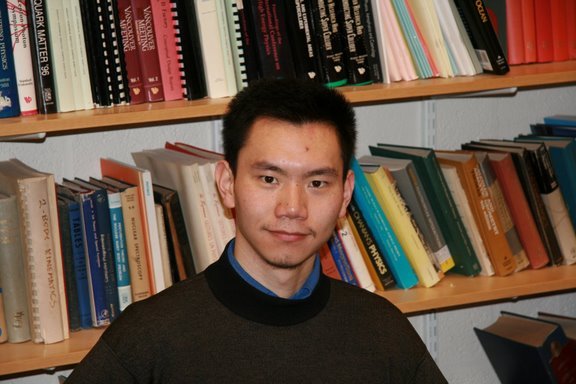 ⇦Ruitian
Lang (percyl ατ mit døt
edu) worked on a UROP project involving adiabatic theorems in
discrete (or discretized) systems in fall 2007.
⇦Ruitian
Lang (percyl ατ mit døt
edu) worked on a UROP project involving adiabatic theorems in
discrete (or discretized) systems in fall 2007.
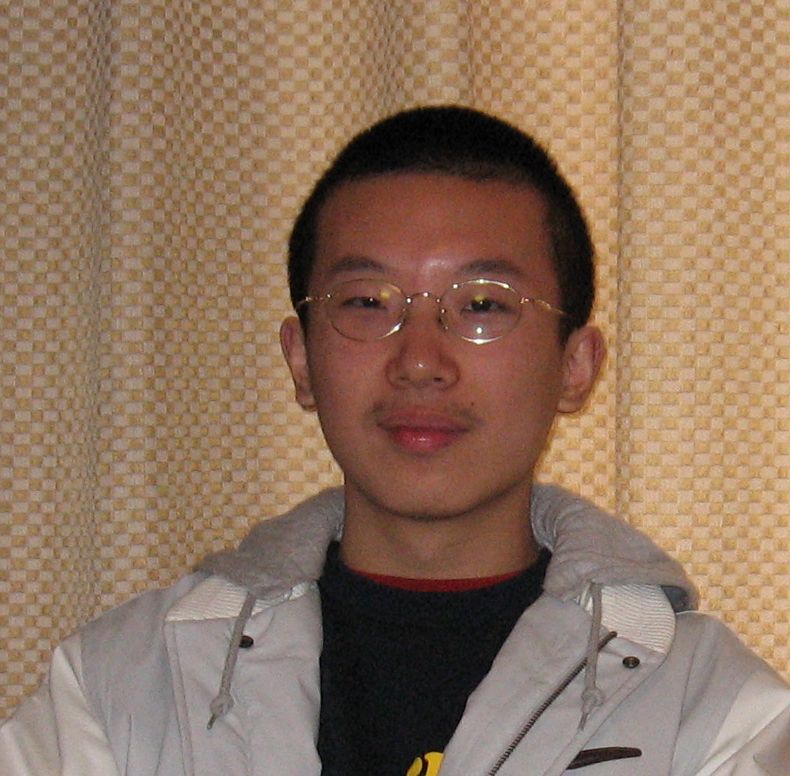 ⇦
Xuancheng Shao (zero ατ mit.edu) worked on UROP projects in 2006 and 2007 involving minimal-arithmetic algorithms for discrete cosine and sine transforms (published here and here).
⇦
Xuancheng Shao (zero ατ mit.edu) worked on UROP projects in 2006 and 2007 involving minimal-arithmetic algorithms for discrete cosine and sine transforms (published here and here).
- Alejandro Rodriguez worked on effects of disorder on photonic-bandgap confinement (published here) and nonlinear thermal radiation (fall 2004 to spring 2006).
Go back to the group web page, or see our publications and preprints.